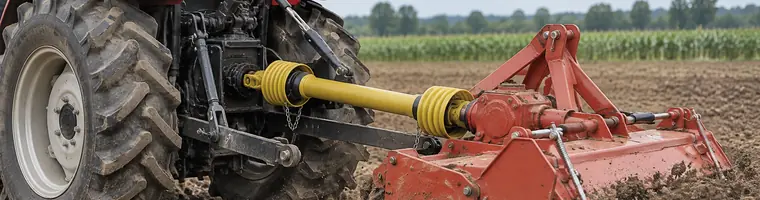
The function of a PTO — Power Take-Off — is to transfer rotational mechanical power from a tractor’s engine to an external driven device, without requiring the tractor to move. Before the PTO was standardised in 1918, implements either had their own engines or were driven by the tractor’s ground wheels through mechanical linkages — a system that only worked when the tractor was moving and wasted significant power through friction.
Today, the PTO performs three distinct functions depending on the application: it drives rotating implement working components directly (the primary function), it powers hydraulic pumps for implements that combine rotary and hydraulic functions, and in some industrial applications it drives auxiliary generators and compressors. The T Series PTO Drive Shaft covers all three functions across the full torque range from 210 Nm to 1,905 Nm.
Primary Function: Driving Implement Working Components
The most important function of the PTO is to deliver continuous rotational power to the working mechanism of an implement. A rotary mower’s blade disc, a round baler’s pick-up reel and baling chamber, a rotary tiller’s tine rotor, a fertiliser spreader’s impeller — all are driven by PTO power transmitted through the cardan shaft from the tractor engine.
The efficiency advantage of the PTO over alternative drive methods is significant. A mechanical shaft transmission delivers 95% or more of available engine power to the implement. A hydraulic system performing the same function — converting engine power to hydraulic pressure and back to rotation — delivers only 70–85%. For high-power continuous-duty applications, the PTO shaft is simply the most efficient power transmission available.
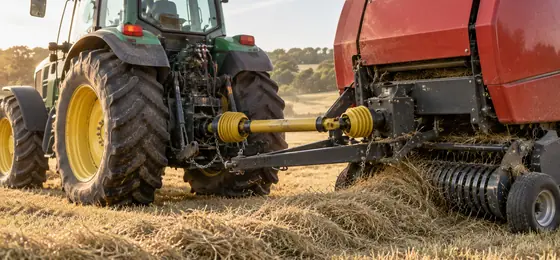
A large round baler requires 35–80 kW at 540 rpm continuously. The PTO shaft is the only practical power delivery method at this level.
Secondary Function: Driving Hydraulic Pumps
Many implements combine rotary and hydraulic functions — a loader that also drives a hydraulic cylinder, a sprayer that uses both a PTO-driven pump and hydraulic boom folding. In these cases, the PTO drives a hydraulic pump that generates the pressure needed for the hydraulic functions. The PTO shaft delivers rotational power to the pump input; the pump converts it to hydraulic flow. This is different from the tractor’s own hydraulic system — the PTO-driven pump operates independently. See the dedicated article on can a PTO power hydraulic systems for details.
Tertiary Function: Industrial and Utility Power Generation
In non-agricultural applications, the PTO performs a broader power generation function. Truck PTOs drive cement mixer drums, refuse compactors, hydraulic crane pumps, and refrigeration compressors. Marine PTOs drive winches, anchor windlasses, and deck cranes. Agricultural utility PTOs drive generators, water pumps, and grain augers. In all cases the function is the same: taking rotational power from a prime mover and delivering it to an auxiliary device.
Why the PTO Function Has Not Been Replaced
Despite the development of electrified tractors and implements, the mechanical PTO shaft remains the dominant power transmission interface for agricultural machinery. The reasons are efficiency (mechanical shaft vs electric motor conversion losses), simplicity (the shaft requires no electronic control system), torque density (a T7 shaft weighing 12 kg transmits 970 Nm — equivalent power from an electric motor weighs 5–10 times more), and the existence of a century-long standardised interface that makes any PTO-spec implement compatible with any PTO-spec tractor.
The PTO is the most successful standardised mechanical interface in agricultural history. The same spline that was defined in 1918 still connects tractors to implements over a century later.
— Agricultural Engineering Review
T Series and L Series — Purpose-Built for Every PTO Function
From compact 10 hp tiller drives to 200 hp forage harvester main shafts. CE certified, sealed cross kits, safety shield standard.
Tags
function of PTOwhat does PTO doPTO purposePTO agricultural functionpower take-off function