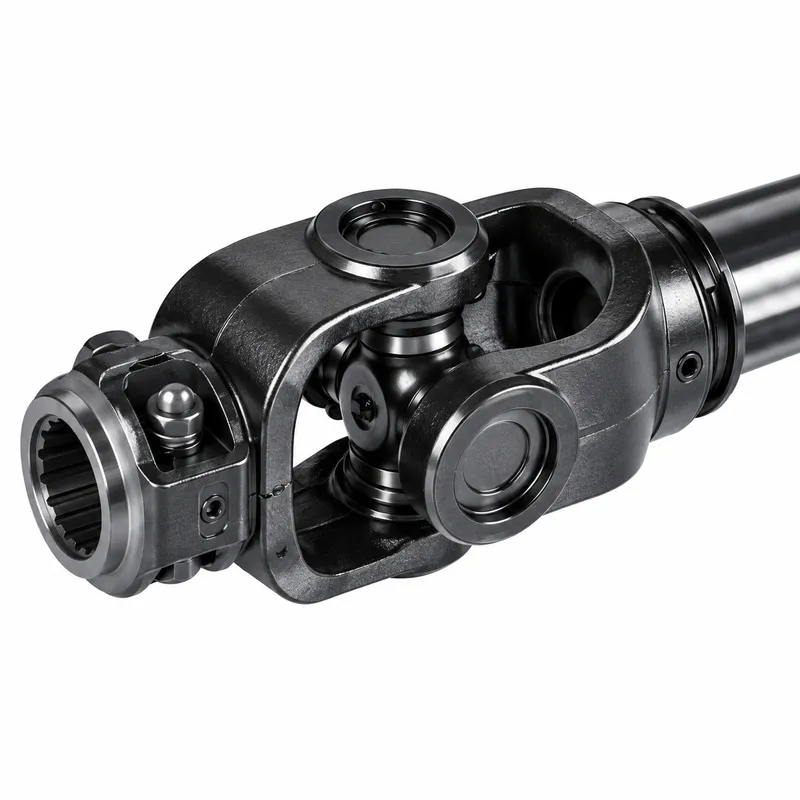
The five most common PTO shaft problems are cross-kit bearing failure, vibration from misalignment or wear, safety shield damage, spline wear at the yoke connection, and tube assembly problems from incorrect shaft length. Each has a distinct symptom pattern and a specific corrective action. Knowing which problem you have before ordering parts saves both time and money.
Problem 1: Cross-Kit Bearing Failure
Cross-kit bearing failure is the most common PTO shaft problem in field use. Symptoms include vibration at all speeds, clicking or knocking under load, visible rust at the bearing cup faces, and perceptible radial play when the shaft is articulated by hand. The root causes are inadequate lubrication and torque overload. Individual replacement cross kits are available for all T and L Series models. Replace at the first sign of play — do not wait for complete failure.
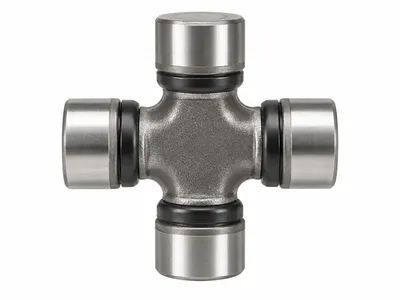
Inspect both cross-kit joints for play, rust, and seal damage at every seasonal inspection.
Problem 2: Vibration
Shaft vibration has three main causes: worn cross-kit bearings (the most common), misphased yoke assembly after cross-kit replacement, and a tube assembly bent by a bottoming-out event or impact. Worn bearings produce a vibration that worsens progressively. Misphased yokes produce vibration immediately after a cross-kit replacement — if vibration appears after a cross-kit change, check that the outer and inner tube yokes are assembled 90 degrees apart (in phase). A bent tube requires full shaft replacement.
Problem 3: Safety Shield Damage or Absence
A cracked, missing, or rotating safety shield is both a safety hazard and evidence of improper shaft handling. Common damage modes include UV degradation of HDPE material after prolonged outdoor storage, mechanical contact with implement components, and bearing seizure causing the shield to rotate with the shaft. Replacement shields are available individually for all series. Operating without a functioning shield is illegal under EU Machinery Directive 2006/42/EC and unsafe by any standard.
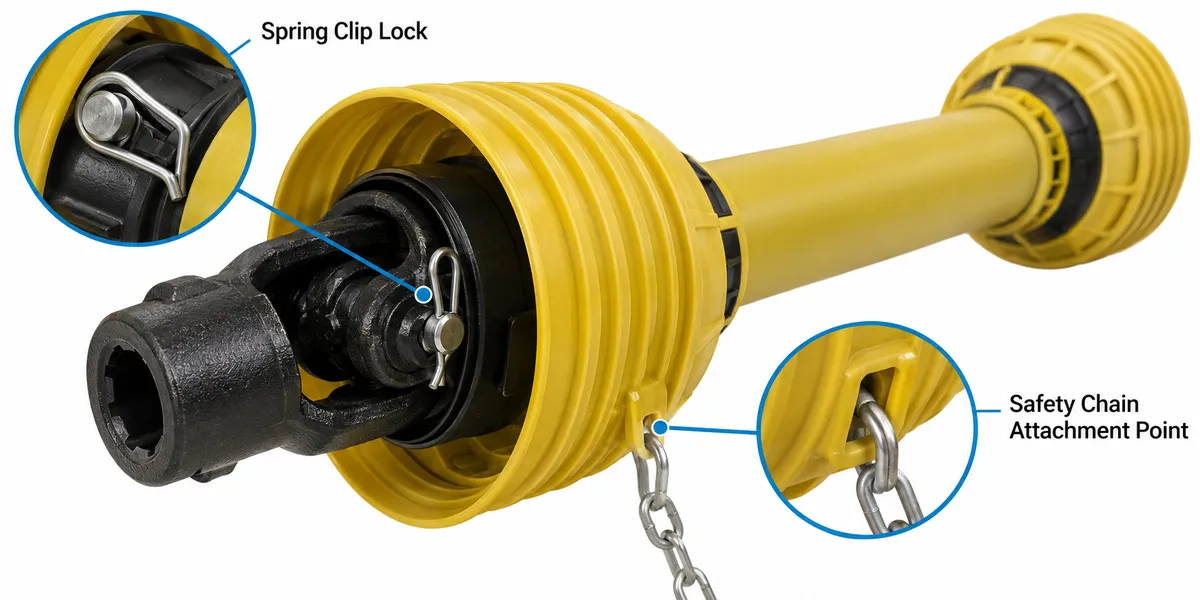
Both safety chains must be connected to fixed, non-rotating points at each inspection.
Problem 4: Spline Wear at Yoke Connection
Spline wear occurs at the interface between the splined yoke bore and the tractor PTO stub or implement input shaft. Symptoms include a loose rattle at the connection point and difficulty engaging or releasing the push-pin lock. The wear is accelerated by partial engagement — the yoke pushed on only far enough for the push-pin to catch without full spline contact. Ensure the yoke is pushed fully onto the stub before the push-pin is released to engage.
Problem 5: Tube Assembly Problems
Tube problems present as either a shaft that will not telescope smoothly (seized from contamination or corrosion) or axial banging when the implement changes height rapidly (tubes bottoming out). A seized tube should be freed with penetrating oil and cleaned before being reassembled with fresh EP2 grease on the contact surfaces. Tubes that are bottoming out require a shorter shaft — measure the coupling centre distance and order the correct stock length.
The most cost-effective PTO maintenance is the simplest: grease every 8 hours, inspect the shield each season, and verify tube overlap when the implement is first connected. These three actions prevent all five common problems.
— Ever-Power Drive Line Maintenance Guide
Cross Kits, Shields, and Splined Yokes — All In Stock
Replacement components for all T Series and L Series models. MOQ 1 piece. Ships to Brazil.
Tags
common PTO shaft problemscross kit failurePTO shaft vibrationPTO spline wearPTO shield damage