
PTO shafts are classified along four dimensions: tube profile (which determines implement housing compatibility), torque class or series (which determines power capacity), joint type (standard cardan vs wide-angle CV), and operating speed (540 rpm vs 1,000 rpm). Understanding all four dimensions is necessary to specify the correct shaft for a given application. The wrong tube profile will not physically fit; the wrong torque class will fail under load; the wrong joint type will produce vibration.
Classification 1: Tube Profile
The tube profile is the cross-sectional shape of the telescoping tube assembly. It determines which implement input housings the shaft will fit. Three profiles are in current agricultural use:
Triangular (Trilobe)
Three-lobe cross-section. The most common profile worldwide. Fits the majority of standard agricultural implement input housings. Used across the T Series range.
Lemon (Elliptical)
Elliptical cross-section. Smaller outer diameter than triangular at the same torque class. Required for European OEM compact baler and tiller housings that exclude triangular profile.
Star (Six-Lobe)
Six-lobe cross-section. Highest torsional rigidity per unit outer diameter. Required for European OEM implement housings machined for star bore specification.
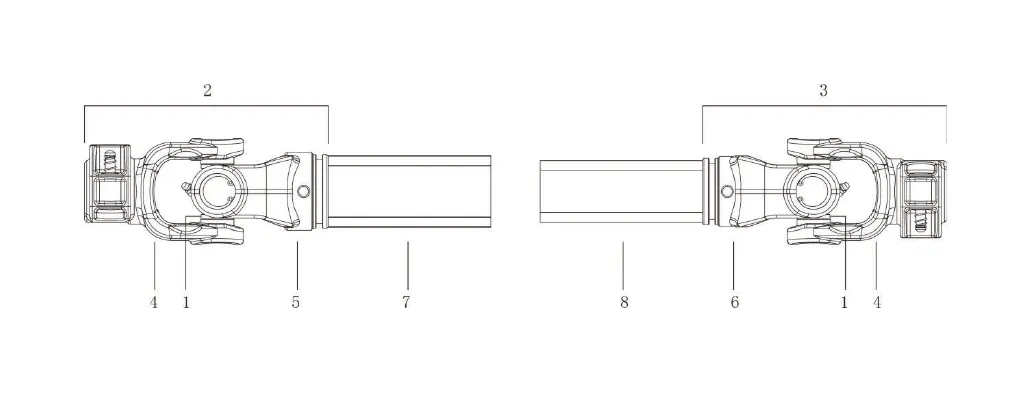
Tube profiles are not interchangeable at the implement input housing. Always confirm the required profile from the implement manual.
Classification 2: Torque Class (Series)
Within each tube profile family, shafts are available in multiple torque classes — identified by series number (T1 through T10, L1 through L32, S6 through S42). The torque class is the primary selection criterion after tube profile. It determines the maximum continuous and peak torque the shaft can transmit without failure.
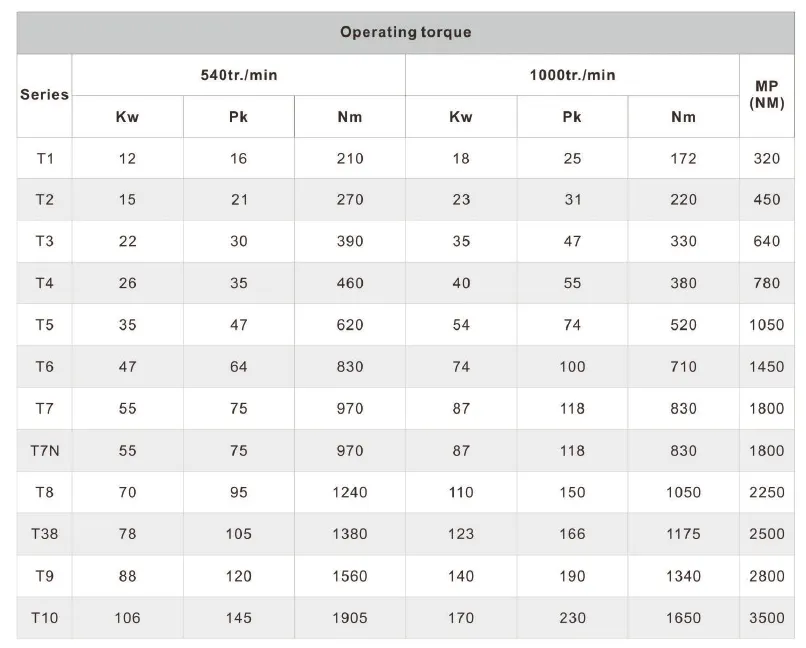
Select the series where Nm@PTO speed meets or exceeds your implement demand plus 20% safety margin.
Classification 3: Joint Type
Стандартний карданний шарнір
Two cross joints, one at each end of the telescoping tube. Maximum continuous operating angle 25 degrees per joint. Produces constant-velocity output when joints are equal and correctly phased. Suitable for 95% of agricultural PTO applications.
Wide-Angle CV Joint
Ball-and-socket constant-velocity joint replaces the tractor-end cardan joint. Maximum operating angle up to 50 degrees. Required for implements mounted very close to the tractor or requiring extreme angle during turns. Available as OEM option on T, L, and S Series.
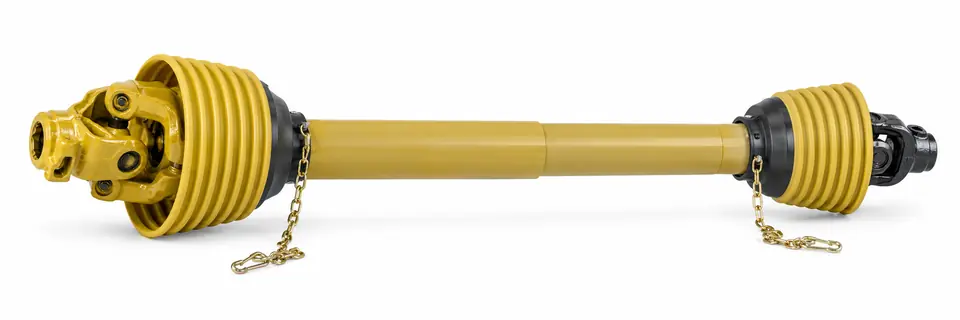
Wide-angle CV joints allow up to 50 degree operating angle at the tractor end, compared to 25 degrees for standard cardan joints.
Classification 4: PTO Speed Standard
All three tube profile families are available for both 540 rpm and 1,000 rpm PTO standards. The speed determines the spline profile required at the yoke ends: 540 rpm uses a 1-3/8 inch 6-spline (Z6) yoke; 1,000 rpm uses a 1-3/4 inch 20-spline (Z20). The torque capacity of the shaft differs between speeds — always select the series using the Nm column for your actual operating PTO speed.
Summary: How to Specify the Correct Type
- 1
Confirm tube profile: Check the implement manual for triangular, lemon, or star bore specification.
- 2
Calculate torque class: Implement power (kW) × 9,549 ÷ RPM + 20% margin. Select the lowest series that meets the adjusted figure.
- 3
Confirm joint type: Standard cardan for angles below 25°; wide-angle CV for angles up to 50°.
- 4
Confirm PTO speed: Count tractor PTO stub splines (6=540rpm, 20=1000rpm) and use the matching Nm column.
- 5
Measure shaft length: Coupling centre distance with implement attached; verify tube overlap at both height extremes.
Specify Your PTO Shaft Type — We Confirm the Correct Series
Send tractor model, implement type, PTO speed, and implement housing specification. Response within 24 hours.
Tags
types of PTO shaftsPTO shaft typestriangular PTO shaftlemon tube PTOstar tube PTOcardan shaft types