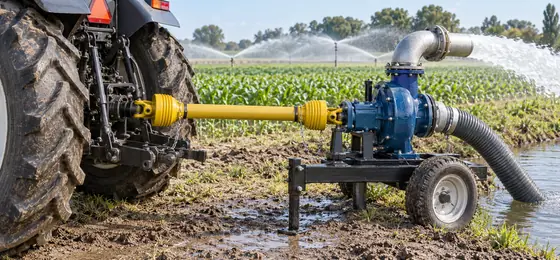
A 1,000 rpm PTO is used for high-power implements that require more power transmission than the 540 rpm standard can efficiently deliver at the same shaft diameter. Implements in this category include large round and square balers, forage harvesters, large rotary mowers, high-capacity fertiliser spreaders, and power generators. The 1,000 rpm PTO delivers approximately 85% more power than 540 rpm at the same shaft torque — making it the standard interface for tractors above 65 hp driving high-demand implements.
Why 1,000 RPM Delivers More Power
Power equals torque multiplied by rotational speed (P = T × ω). At the same shaft torque (Nm), doubling the speed from 540 to 1,000 rpm nearly doubles the transmitted power. This means a shaft rated at 520 Nm at 1,000 rpm transmits approximately 54 kW — roughly 75 hp — the same shaft at 540 rpm would transmit only 29 kW at 520 Nm. The 1,000 rpm standard allows high-power transfer through a shaft of the same physical size.
Implements That Require 1,000 RPM PTO
- ✓Large round balers (chamber diameter 1.5 m+): High-density baling with large pick-up widths requires continuous power delivery above the 540 rpm envelope.
- ✓بڑے مربع بیلر: Knotting and plunger mechanisms on high-output square balers demand sustained 60+ kW PTO input.
- ✓Self-loading forage wagons: Pick-up, rotor, and auger drives combined can exceed the 540 rpm rating of even T6 series.
- ✓High-capacity fertiliser spreaders: Large impeller spreaders with hydraulic fan assist. The hydraulic pump drive alone may require 1,000 rpm input.
- ✓Industrial generators and compressors: PTO-driven generators on farm utility vehicles typically require 1,000 rpm for correct alternator speed.
- ✓Large rotary mowers (3 m+): High-blade-count mowers on 80+ hp tractors exceed the 540 rpm torque capacity of the equivalent shaft series.
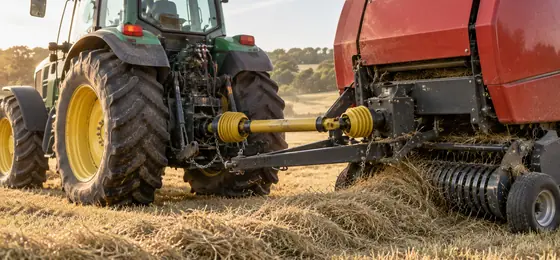
High-density round balers on 80+ hp tractors routinely require 1,000 rpm PTO for rated throughput.
1,000 RPM PTO Shaft Identification
A 1,000 rpm PTO uses a 1-3/4 inch 20-spline (Z20) yoke profile — physically larger in diameter than the 540 rpm Z6 spline. Counting 20 splines on the tractor PTO stub confirms you have a 1,000 rpm PTO. Some tractors carry both a 540 rpm stub and a 1,000 rpm stub, or a single variable-speed stub selectable through a tractor control — check the tractor operator manual for the configuration.
1,000E Economy PTO
The 1,000E (economy) PTO variant delivers 1,000 rpm at reduced engine speed — typically 1,400–1,700 rpm rather than the 2,000+ rpm of standard 1,000 rpm PTO. This improves fuel efficiency for continuous high-power applications such as large balers and forage equipment. The shaft interface is the same Z20 spline — the economy designation refers to the engine speed at which 1,000 rpm is achieved, not the shaft connection.
Selecting the Correct T Series or L Series for 1,000 RPM
When selecting a shaft for a 1,000 rpm application, use the Nm@1000 column from the T Series torque table. The rated torque at 1,000 rpm is lower than at 540 rpm for the same shaft series, because the higher rotational speed increases dynamic loads on the cross-kit bearings. For example, T6 is rated at 830 Nm at 540 rpm but 710 Nm at 1,000 rpm. Always calculate the implement demand at the actual operating PTO speed before selecting the series.
Specify Your 1,000 RPM Application
T Series and L Series shafts available with Z20 spline for 1,000 rpm PTO. Full torque table and series selection support available.
ٹیگز
1000 rpm PTO1000 rpm PTO used forhigh speed PTOZ20 spline PTOPTO power transmission