PTO shaft failures fall into a small number of predictable categories. Understanding the root cause of each failure mode allows operators to make better maintenance decisions, select the correct shaft specification, and avoid the costly downtime associated with mid-season shaft replacement. This guide covers the seven most common PTO shaft problems, their causes, their symptoms, and how to prevent them.
All failure modes discussed here are addressed in the design of the T Series PTO Drive Shaft range, which uses sealed IP67 cross-kit bearings, induction-hardened yoke bearing seats, and a CE-certified safety shield as standard. However, no shaft is failure-proof under neglect or misspecification.
1. Cross-Kit Bearing Failure
Cross-kit bearing failure is the most common PTO shaft problem in agricultural use. The cross kit is the universal joint at each end of the shaft, consisting of a four-armed cross body and four needle-roller bearing cups. Under normal operating conditions, these bearings run in EP2 grease at high cyclic loads and articulation angles. Under adverse conditions — insufficient lubrication, soil ingress, or overloading — they fail rapidly.
Symptoms
- ●Vibration or shuddering at any shaft speed
- ●Clicking or knocking sound under load, especially on start-up
- ●Visible rust or discolouration at the cross-kit bearing cups
- ●Perceptible radial play when the shaft is articulated by hand
Root Causes
The two primary causes of cross-kit bearing failure are inadequate lubrication and overloading. Inadequate lubrication — the most common — results from infrequent greasing, use of the wrong grease type, or damaged seals that allow grease to escape and contaminants to enter. Overloading occurs when the shaft series is undersized for the implement demand, causing the cross-kit bearings to operate close to or above their rated capacity.
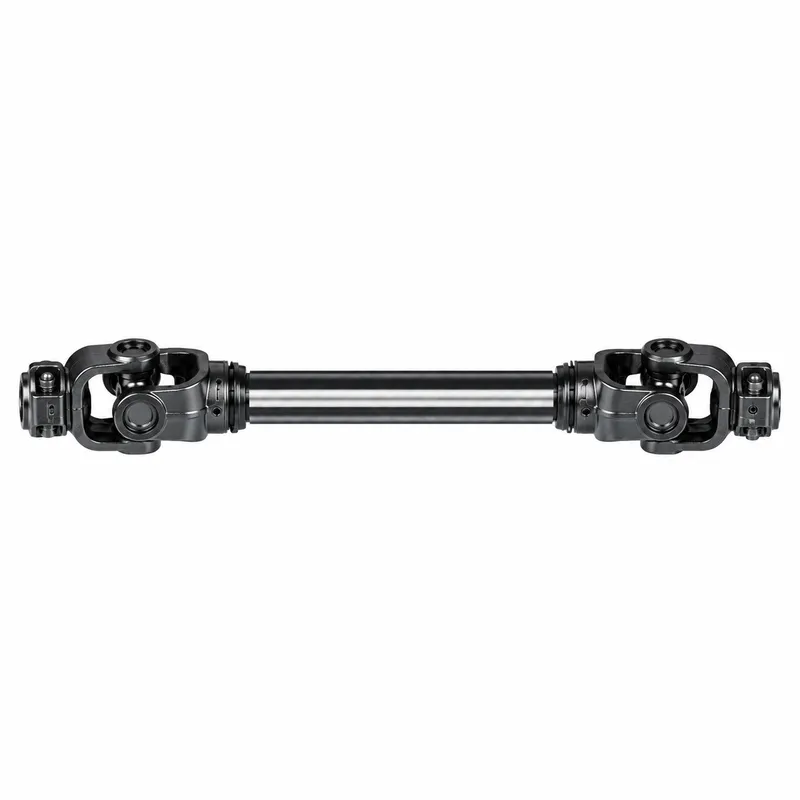
Side view: cross kit assembly in the T Series shaft. Grease nipple visible at each cross arm — accessible with shield fitted.
2. Shaft Vibration
Shaft vibration is the second most reported PTO shaft problem. It manifests as a rough, shaking sensation transmitted through the tractor seat and controls during PTO operation. Vibration can be caused by cross-kit bearing wear (see above), yoke misalignment, a bent or deformed tube assembly, or a shaft length that places the working angle at the joints above the recommended maximum.
The recommended maximum continuous operating angle for most T Series cardan joints is 25 degrees. Operating above this angle significantly increases bearing load at the cross kits and produces cyclic velocity variation in the output shaft — which is perceived as vibration by the operator.
3. Safety Shield Damage or Absence
A damaged or missing safety shield is both a safety problem and an early indicator of shaft handling problems. HDPE bellows shields are durable but not indestructible. Common damage modes include UV degradation of the bellows material after prolonged outdoor storage without the shield in place, cracking of the plastic bearing at the shield ends, and mechanical damage from implement contact.
Every T Series shaft is supplied with a CE-marked HDPE safety shield. Replacement shields are available individually for all series. Operating without a functioning shield is illegal under EU Machinery Directive 2006/42/EC and creates unacceptable safety risk. Contact the drivelines.net team for replacement shields before the next use.
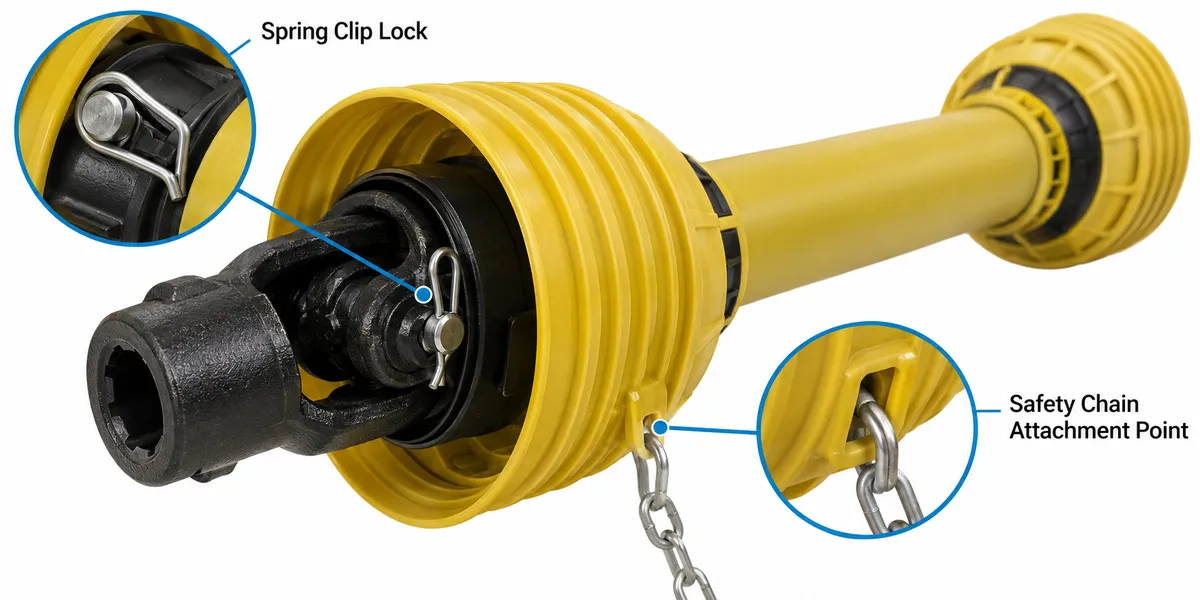
Safety shield installation: chain anchors at both ends must be connected to fixed, non-rotating points.
4. Yoke Spline Wear
Spline wear occurs at the interface between the push-pin yoke and the tractor PTO stub or implement input shaft. This wear is accelerated by incorrect spline engagement — particularly when the yoke is pushed on only partially before the push-pin is allowed to engage — and by operating with loose or worn yoke locking mechanisms. Symptoms include a loose rattle at the yoke connection and difficulty removing or inserting the yoke.
5. Tube Assembly Problems
The inner and outer tubes of the T Series shaft telescope to accommodate length changes as the implement moves. Problems in the tube assembly typically result from incorrect shaft length specification (tubes bottoming out at minimum implement height), operation at excessive angles (causing tube binding), or contamination of the tube interior with soil or crop material that prevents smooth telescoping.
A shaft that bottoms out at minimum implement height generates axial thrust loads that the cross-kit bearings are not designed to absorb. This causes accelerated bearing wear and can result in yoke fracture in severe cases. Always verify minimum tube engagement (80 mm minimum at full compression) before operation.
6. Torque Overload Failure
Torque overload failure occurs when the implement demands more torque than the shaft is rated to provide. This typically happens at start-up (when inertia loads peak), during slug loading (when a baler processes a dense windrow or a mower hits a heavy crop), or when the shaft series has been undersized. The designed failure point is the cross-kit bearing — the shaft is designed so that the cross kit fails before the more expensive implement gearbox. A shear bolt torque limiter prevents this by releasing at a preset torque before the shaft reaches its limit.
7. Corrosion and Paint Failure
Corrosion of the tube exterior and yoke bodies reduces the structural integrity of the shaft over time. It is most severe in high-humidity environments (tropical and subtropical climates, irrigated operations), in shafts that are stored without covers, and in shafts that have suffered paint damage from contact with soil or implements.
T Series shafts from Ever-Power Drive Line receive an electrostatic powder-coat finish, with the yoke bearing seats and tube interior coated with a rust-inhibiting oil before assembly. Salt-spray testing to 120 hours per ISO 9227 is part of the outgoing quality inspection. Even so, shafts stored outdoors should be protected with a dust cap on the splined yoke ends.
The most cost-effective PTO shaft maintenance is also the simplest: grease every 8 hours, inspect the shield before each season, and verify that the shaft is the correct series for the implement.
— Ever-Power Drive Line Maintenance Guide
Maintenance Schedule to Prevent All Seven Problems
- 1
Before each season: Inspect shield for cracks, missing chain anchors, and non-rotating bearing. Replace if any damage found.
- 2
Before first use: Apply 2–3 pumps EP2 lithium grease to each cross-kit nipple. Verify push-pin yoke engagement at both ends.
- 3
Every 8 hours of operation: Re-grease cross-kit nipples with EP2. Halve this interval in wet, abrasive, or waterlogged conditions.
- 4
Monthly: Check for radial play in cross-kit joints. Check tube telescoping for smooth action. Check yoke spline for loose engagement.
- 5
At season end: Clean shaft exterior, inspect for corrosion, apply light oil to exposed metal, store in a dry location with dust caps on yoke splines.
- 6
After any slug load event: Inspect cross kits for play and bearing cup displacement before returning to operation.
Replace Cross Kits Before They Fail
Individual cross kit replacement parts are available for all T Series models. Replacing a worn cross kit before failure costs 5-10% of the full shaft price and eliminates mid-season downtime. MOQ 1 piece.
Tags
PTO shaft problemscross kit failurePTO shaft vibrationPTO shield damagePTO shaft maintenanceagricultural driveline