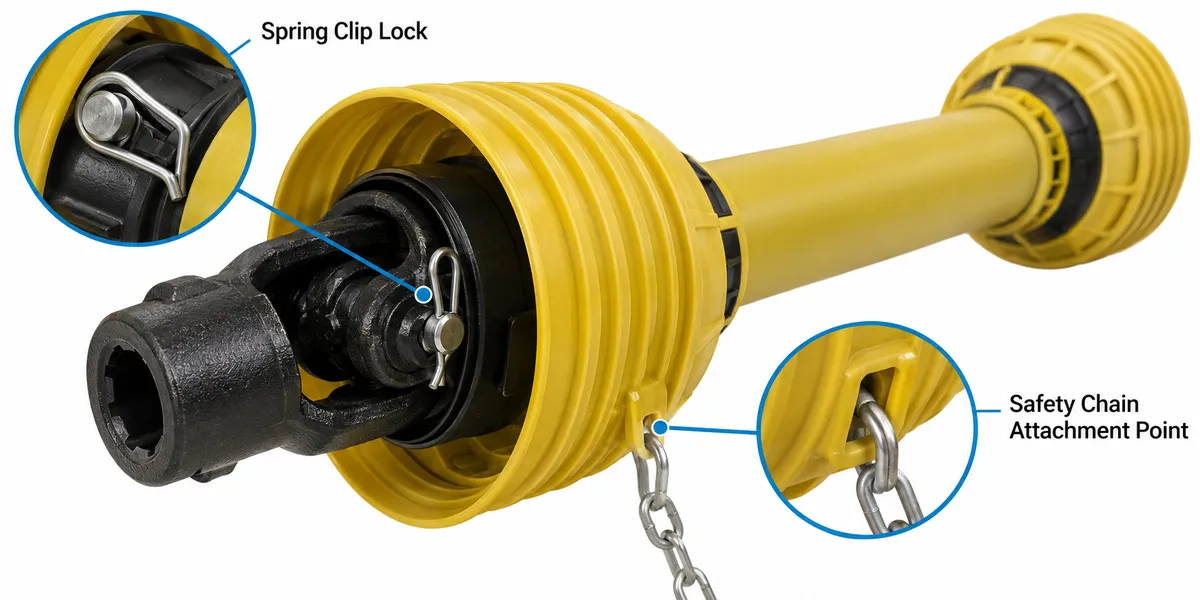
Getting caught in a spinning PTO shaft is one of the most violent and lethal events that can occur on a farm. A PTO shaft rotating at 540 rpm completes nine full rotations per second. At that speed, clothing, limbs, or hair caught in the shaft leave no time to react. Understanding what happens — and how to prevent it — is not optional for anyone who operates tractor-powered implements.
This article explains the mechanics of PTO entanglement injuries, the safety systems designed to prevent them, and the minimum equipment and procedures that every operator must follow. The T Series PTO Drive Shaft range from Ever-Power Drive Line is supplied with a CE-certified safety shield as standard on every unit — not as an accessory.
The Mechanics of PTO Shaft Entanglement
When loose clothing, a rope, or a limb contacts a rotating PTO shaft, the rotation wraps the material around the shaft in a fraction of a second. At 540 rpm, the shaft completes one full rotation in 111 milliseconds — approximately the time it takes the human brain to register that contact has occurred, let alone initiate a withdrawal reflex.
The wrapping force is proportional to shaft diameter and speed. A standard PTO shaft running at 540 rpm generates a peripheral velocity at the shaft surface of approximately 1.5 metres per second. Once wrapping begins, the force escalates with each rotation as more material winds around the shaft, creating a self-reinforcing mechanism that draws the victim toward the rotating components.
The injuries that result are characteristic and catastrophic. Degloving — the stripping of skin and soft tissue from bone — occurs as the rotating shaft pulls clothing and skin in opposite directions. Limb fractures occur as the leverage force of the wrapped material exceeds bone tensile strength. Fatalities occur when the victim’s torso is drawn into the rotating assembly.
Entanglement Takes Under 100 Milliseconds
The human reaction time to an unexpected contact is approximately 150 milliseconds. A PTO shaft running at 540 rpm completes more than one full rotation in that time. There is no safe response to PTO contact — prevention is the only protection.
Why the Safety Shield Exists
The CE safety shield — mandated by EU Machinery Directive 2006/42/EC and OECD Code 4 — is an HDPE bellows guard that encloses the entire rotating shaft assembly. Its purpose is to create a physical barrier between the rotating components and the operator environment. The shield itself does not rotate: it is anchored at both ends by safety chain brackets attached to fixed, non-rotating points on the tractor and implement.
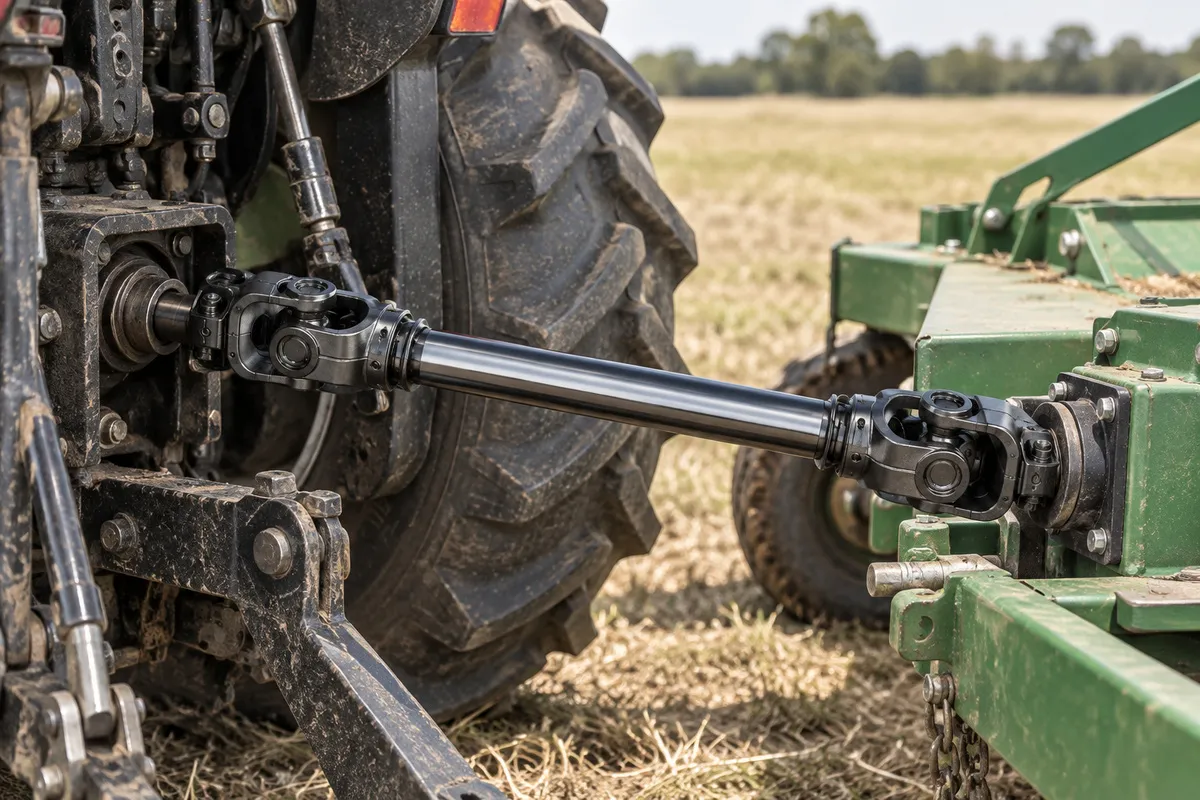
Correct installation: shaft shielded end-to-end, safety chains taut, chains anchored to fixed frames.
When correctly installed, the shield prevents direct contact with the rotating shaft at any point along its length. The chains prevent the shield from rotating with the shaft if the plastic bearing at either end seizes. A seized, rotating shield is itself a hazard — the chain system eliminates this risk.
Shield Removal is the Most Common Fatal Error
Field investigations of PTO fatalities consistently identify the same root cause: the safety shield was absent, damaged, or had been deliberately removed. Operators remove shields for several reasons — to inspect the shaft, to re-grease cross-kit nipples, or because a worn shield makes noise. None of these reasons justify operating without a shield.
Replacement shields are available as individual spare parts for all T Series models. The cross-kit grease nipple on Ever-Power Drive Line T Series shafts is positioned to be accessible with the shield in place, eliminating the most common reason for shield removal. If your shield is damaged or missing, contact the drivelines.net team for a replacement before the next use.
Safe Operating Procedures
- 1
Never approach a running PTO shaft from any direction. The minimum safe distance is beyond the implement footprint.
- 2
Disengage the PTO and wait for all rotation to stop completely before approaching the shaft, coupling or uncoupling implements, or clearing blockages.
- 3
Inspect the safety shield before each use. A cracked, missing, or non-rotating shield must be replaced before operation.
- 4
Secure both safety chains to fixed, non-rotating points. Chains should be taut but not tensioned under normal implement movement.
- 5
Wear close-fitting clothing with no loose ends, drawstrings, or open cuffs when operating PTO equipment.
- 6
Mark the PTO isolation procedure on the implement and tractor so that relief operators follow the same protocol.
The Role of the Torque Limiter in Safety
While a torque limiter is primarily an equipment protection device, it also contributes indirectly to operator safety. When an implement jams — a common event in baling, rotary cutting, and forage harvesting — the sudden torque spike can cause the tractor to stall, the shaft to fracture, or the implement to kick. A shear bolt torque limiter releases cleanly at a preset torque, stopping the power transmission without a sudden mechanical event. This reduces the likelihood of panic responses that lead to operator contact with rotating components.
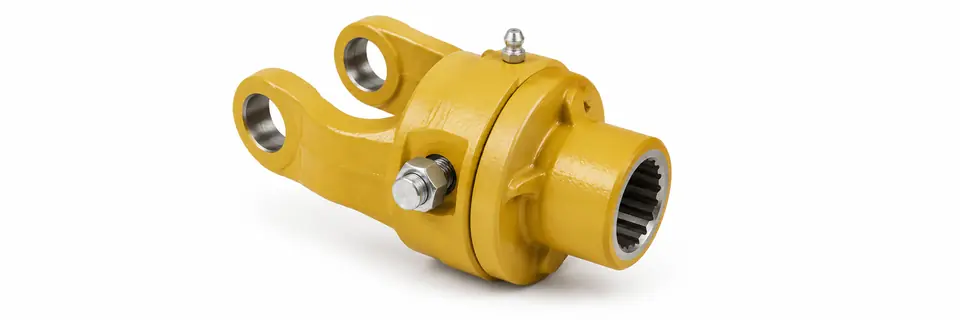
Shear bolt torque limiter: fails safely at preset torque, preventing sudden implement kickback.
The leading contributing factor in PTO fatalities is not speed or proximity — it is complacency. The operator has performed the same task hundreds of times without incident and stops treating the shaft as the hazard it is.
— Agricultural Safety Research Institute
Emergency Response if Entanglement Occurs
If entanglement occurs, the immediate priority is to stop shaft rotation. On a tractor, the PTO disengage lever or the tractor master clutch can stop rotation if the operator remains conscious and in reach of the controls. Emergency observers should never attempt to pull the victim free — this worsens the injury by exerting force against the wrapped material. The correct action is to reverse the shaft rotation if possible, or disengage power and call emergency services immediately.
Most tractors do not have a PTO reverse function. In this case, the only option is to disengage power and wait for rotation to cease. Do not attempt to cut the shaft with hand tools while under load.
Legal Requirements for PTO Safety Shields
In the European Union, all new PTO shafts must be CE-marked under the Machinery Directive 2006/42/EC. The shield must meet OECD Code 4 requirements. In Brazil, ABNT NBR standards apply to agricultural machinery, with CE documentation accepted for import compliance. The CE Declaration of Conformity and OECD shield compliance documentation are available with every Ever-Power Drive Line T Series shaft.
Replace Missing or Damaged Safety Shields Before the Next Use
Every T Series PTO Drive Shaft from Ever-Power Drive Line is supplied with a CE-compliant HDPE safety shield as standard. Replacement shields are available for all series. MOQ 1 piece. Ships to Brazil and South America.
Tags
PTO SafetyPTO ShieldFarm SafetyCE ShieldOECD Code 4Agricultural SafetyPTO Entanglement