
PTO stands for Power Take-Off. The name is a direct description of the mechanical function: it is the mechanism by which rotational power is taken off the tractor’s engine output and transferred to an external implement. The term has been in agricultural use since the first standardised PTO system was introduced in 1918, and it remains the universal designation for this type of power transmission interface across all languages in the agricultural machinery industry.
Today, the PTO system connects the tractor to a vast range of implements through a standardised shaft interface. The T Series PTO Drive Shaft from Ever-Power Drive Line represents the current engineering standard for this connection — a telescoping cardan shaft with CE-certified safety shield, connecting the tractor PTO stub to the implement input shaft.
The Origin of the Term Power Take-Off
The expression Power Take-Off appeared in agricultural engineering literature in the early twentieth century to describe a new concept in tractor design: rather than requiring the tractor to move to do work (as with a plough), the tractor could stand still and deliver rotational power to a stationary implement through a dedicated output shaft.
The first standardised agricultural PTO was introduced by International Harvester in the United States in 1918, on the Farmall tractor. The design established the foundational principle that remains unchanged today: a rotating shaft at the rear of the tractor, standardised in speed and spline profile, to which any compatible implement could be connected.
The IHC 1918 PTO ran at 536 rpm — later rounded to 540 rpm — driving a standard 1-3/8 inch 6-spline shaft. This specification was formalised internationally by the OECD and ISO in the mid-twentieth century and remains the dominant agricultural PTO standard globally.
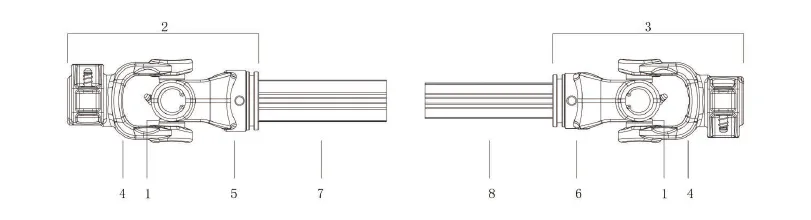
The modern PTO shaft: cardan joints (1,2,3), splined yokes (4), tube yokes (5,6), and telescoping tubes (7,8).
What PTO Means in Engineering Terms
In mechanical engineering, a power take-off is any device that transfers mechanical power from a prime mover — an engine, motor, or turbine — to an auxiliary piece of equipment. The agricultural tractor PTO is the most widely known example, but PTO systems exist in trucks (driving cement mixers and hydraulic pumps), marine vessels (driving deck winches), and industrial machinery (driving compressors and generators).
In the agricultural context, the PTO has three standard operating speeds. The 540 rpm standard, introduced in 1918, remains the most common for light to medium duty implements in the 10 to 100 hp tractor class. The 1,000 rpm standard was introduced for higher-power applications requiring greater power transmission at the same shaft size. The 1,000E (economy) standard operates at 1,000 rpm but at reduced engine speed, improving fuel efficiency.
PTO Shaft Anatomy: Why the Name Fits
The PTO system consists of three primary components. The PTO stub is the short output shaft protruding from the rear of the tractor. The PTO drive shaft — the cardan shaft — connects the tractor stub to the implement input shaft, accommodating the changing angle and distance as the implement moves relative to the tractor. The implement input shaft transmits the rotational power into the implement’s gearbox or working mechanism.
540 rpm PTO (Standard)
Standard spline: 1-3/8 inch 6-spline (Z6). Used for tillers, mowers, balers, spreaders, and pumps up to approximately 65 hp output. The most common configuration worldwide.
1,000 rpm PTO (High Speed)
Standard spline: 1-3/4 inch 20-spline (Z20). Used for high-power implements on tractors above 65 hp. Delivers more power at the same shaft torque due to higher rotational speed.
The splined yoke at each end of the PTO drive shaft is the component that engages the PTO stub and the implement input shaft. The spline profile must match exactly — a 540 rpm Z6 yoke will not fit a 1,000 rpm Z20 stub. This is why confirming the PTO stub type is the first step in shaft selection.
Why Is It Always Called a PTO and Not Something Else?
The persistence of the term PTO across multiple languages — German: Zapfwelle (tap shaft), French: prise de force (power take), but universally abbreviated PTO in technical and commercial contexts — reflects the global standardisation of the system itself. When a standard is universal, its name becomes universal.
In agricultural machinery catalogs, technical standards (ISO 500, ASAE S203), and trade documentation, PTO is the accepted term across English, Portuguese, Spanish, and most European languages. Brazilian agricultural import documentation, INMETRO compliance submissions, and LGPD data handling documentation all reference PTO by this abbreviation.
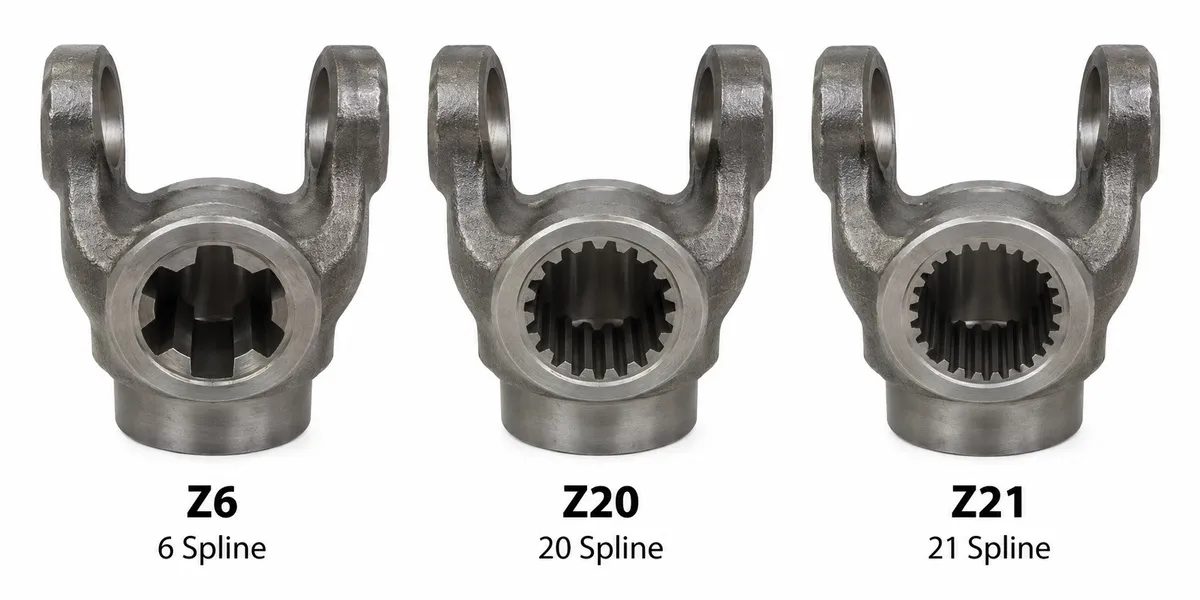
Spline profile comparison: left Z6 (540 rpm standard), right Z20 (1,000 rpm high-speed).
PTO vs Hydraulic Power: Why the PTO Survived
The agricultural tractor also provides hydraulic power through the three-point linkage hydraulic system. Despite the availability of hydraulic power, the PTO remained the dominant method for driving high-power rotating implements for over a century. The reason is efficiency: a mechanical shaft transmission is inherently more efficient than converting engine power to hydraulic pressure, transmitting it through hoses and a hydraulic motor, and converting back to rotation. For high-power continuous-duty applications such as balers, mowers, and forage harvesters, the PTO shaft delivers 95% or more of available engine power, compared to 70-85% for equivalent hydraulic systems.
The PTO shaft is one of the most successful standardised interfaces in agricultural engineering history. The same 1-3/8 inch Z6 spline introduced in 1918 still connects tractors to implements over a century later.
— Agricultural Engineering Review
PTO Shafts Today: The T Series Standard
Modern T Series PTO drive shafts such as the T5 (620 Nm) and T6 (830 Nm) represent over a century of refinement of the original 1918 concept. The telescoping tube allows length adjustment as the implement rises and falls. The cardan joints at each end maintain power transmission through the changing angle. The sealed needle-roller cross kits reduce maintenance intervals. The CE-certified HDPE safety shield makes the system legally compliant with modern safety regulations.
The fundamentals of the PTO system — a standardised rotating shaft delivering engine power to an implement — remain unchanged from the original concept. What has changed is the quality, safety, and torque capacity of the shaft that makes the connection. For technical specifications and the full T Series range, see the PTO Drive Shaft category at drivelines.net.
Browse the Full T Series PTO Drive Shaft Range
T1 to T10 — 210 Nm to 1,905 Nm at 540 rpm. CE certified, ISO 9001, sealed cross kits. MOQ 1 pc. Ships to Brazil. Full LGPD documentation.
Tags
PTO meaningPower Take-OffPTO history540 rpm1000 rpmPTO standardagricultural driveline