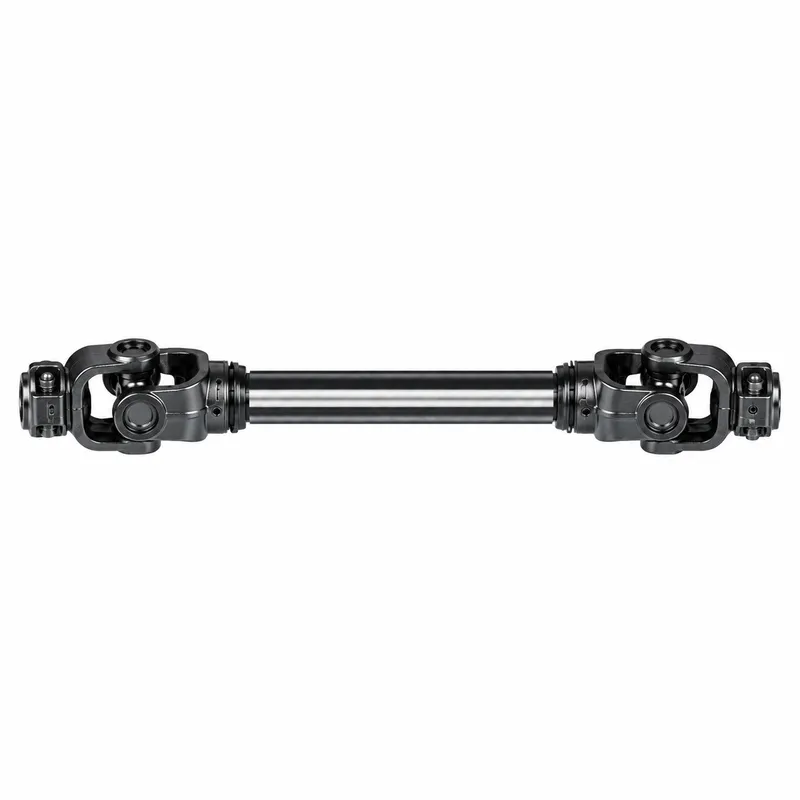
A PTO shaft breaks for one of four reasons: the implement demanded more torque than the shaft series is rated for, the shaft was fitted at an angle beyond its design limit, the shaft length caused the telescoping tubes to bottom out, or the cross-kit bearings failed and the resulting vibration fatigued the yoke material. Understanding the cause prevents the same failure recurring on the replacement shaft.
Cause 1: Torque Overload — Most Common
Torque overload occurs when the implement demands more Nm than the shaft is rated to absorb. This most frequently happens at PTO engagement — the moment of highest inertia load — and during slug loading events such as a baler encountering a dense windrow or a tiller hitting compacted soil.
The shaft is designed so that the cross-kit bearing is the first component to fail under overload, because it is cheaper to replace than the implement gearbox. However, if the overload is severe enough — or occurs repeatedly — the yoke body can fracture at the bearing seat. A shear bolt torque limiter releases at a preset torque before the shaft reaches its limit, preventing this failure entirely.
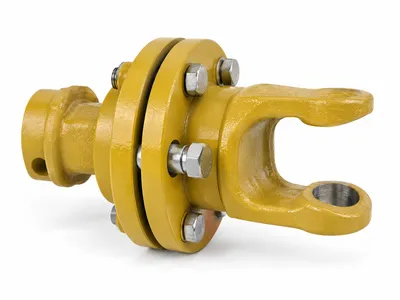
A torque limiter set below the shaft peak rating prevents overload fracture.
Cause 2: Operating Angle Too High
Every cardan joint has a maximum continuous operating angle — for T Series and L Series shafts this is 25 degrees at each joint. Operating above this angle does not cause immediate failure, but it dramatically increases the load on the cross-kit bearing cups, accelerating wear. Over time, the bearing cups fail, the cross-kit seizes, and the resulting vibration fatigues the yoke at the bearing seat.
The angle is determined by the hitch geometry: the height difference between the tractor PTO stub and the implement input shaft. Implements mounted too high or too low exceed this limit. The correct approach is to adjust the three-point hitch to bring the two shaft ends as close to parallel as possible.
Cause 3: Shaft Tubes Bottoming Out
When the implement is lowered to its minimum working position and the telescoping tubes run out of travel — the inner tube contacts the outer tube end stop — the shaft can no longer shorten. Any further lowering of the implement transmits compressive axial force through the shaft into the tractor PTO stub bearing and the implement gearbox. This force is not what either bearing is designed to absorb, and it causes premature failure of both.
The minimum required compression clearance is 80 mm of tube engagement at the lowest implement position. Measure this with the implement fully lowered before the first use of a new shaft.
Cause 4: Cross-Kit Bearing Fatigue Leading to Yoke Fracture
A cross-kit bearing that has run dry — either because the lubrication interval was missed, or because the grease seal failed and allowed contamination — generates heat and metallic debris inside the bearing cup. The debris increases bearing play, which increases vibration amplitude. Sustained high-amplitude vibration fatigues the yoke at the bearing seat until the yoke fractures. This failure mode is entirely preventable through a consistent lubrication schedule and annual seal inspection. See the cross kit replacement page for part numbers.
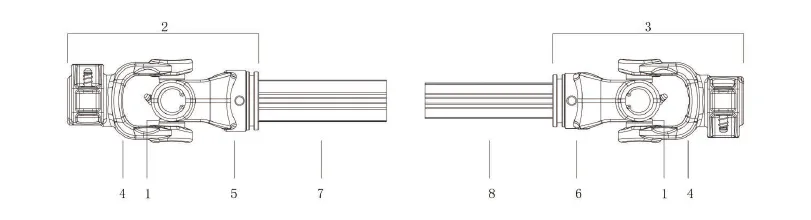
Correct angle and tube overlap at both extremes of implement travel prevent premature shaft failure.
How to Prevent Recurrence on the Replacement Shaft
- ✓Verify the torque rating: Calculate implement demand (Nm) at operating PTO speed, add 20% safety margin, select the lowest T Series or L Series that meets the adjusted figure.
- ✓Fit a torque limiter: Set the release torque below the shaft peak rating on all baler, tiller, and mower applications.
- ✓Measure tube overlap: At full implement compression, confirm 80 mm minimum engagement. At full extension, confirm 50 mm minimum overlap.
- ✓Check operating angle: At normal working height, both cardan joints should operate below 25°.
- ✓Grease every 8 hours: EP2 lithium complex NLGI 2, 2–3 pumps per cross-kit nipple.
Specify the Correct Replacement Shaft
Send your tractor model, implement type, and the failure description. Ever-Power Drive Line will confirm the correct T Series or L Series and whether a torque limiter is required.
Tags
PTO shaft breaksPTO shaft fracture causestorque overload PTOPTO shaft anglecardan shaft failure