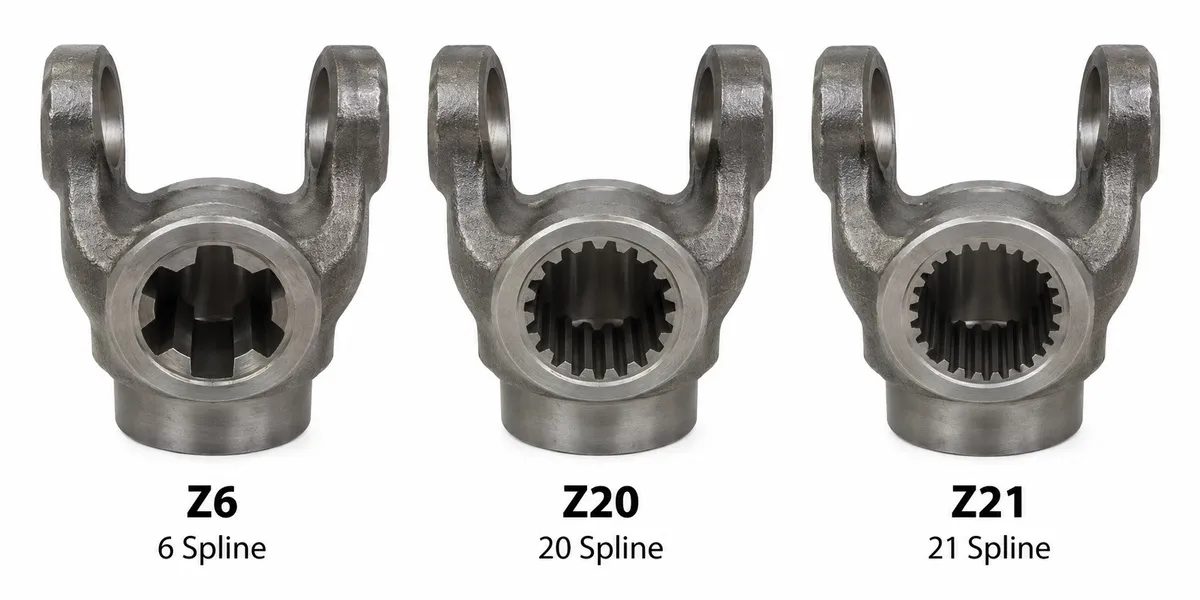
The difference between a 540 rpm and 1,000 rpm PTO shaft is the rotational speed at which power is delivered, the spline profile required at each end, and the resulting power capacity at the same shaft torque. A 540 rpm PTO uses a 1-3/8 inch 6-spline (Z6) stub; a 1,000 rpm PTO uses a 1-3/4 inch 20-spline (Z20) stub. These are physically different sizes — a Z6 yoke will not engage a Z20 stub, and vice versa. There is no functional overlap and no adapter between standard configurations.
Speed and Spline: The Two Primary Differences
540 rpm (Standard)
Spline: 1-3/8 inch, 6-spline (Z6)
Stub OD: 34.9 mm
Tractors: Most tractors up to ~65 hp
Implements: Tillers, mowers, spreaders, small balers, pumps
Power at 540 rpm T6: 47 kW (63 hp)
The original 1918 standard. Still the dominant specification for the majority of agricultural implements worldwide.
1,000 rpm (High-Speed)
Spline: 1-3/4 inch, 20-spline (Z20)
Stub OD: 44.5 mm
Tractors: Mid and large tractors above ~65 hp
Implements: Large balers, forage harvesters, large mowers, generators
Power at 1000 rpm T6: 74 kW (99 hp)
Introduced for high-power applications. Delivers approximately 85% more power than 540 rpm at the same shaft torque.
Why 1,000 RPM Delivers More Power at the Same Torque
Power equals torque multiplied by rotational speed (P = T × ω). At the same shaft torque (Nm), operating at 1,000 rpm delivers 85% more power than operating at 540 rpm. This means a T6 shaft transmits 47 kW at 540 rpm and 74 kW at 1,000 rpm — same shaft, same cross-kit, different speed. The 1,000 rpm standard was introduced specifically to allow more power delivery through a shaft of practical size and weight.
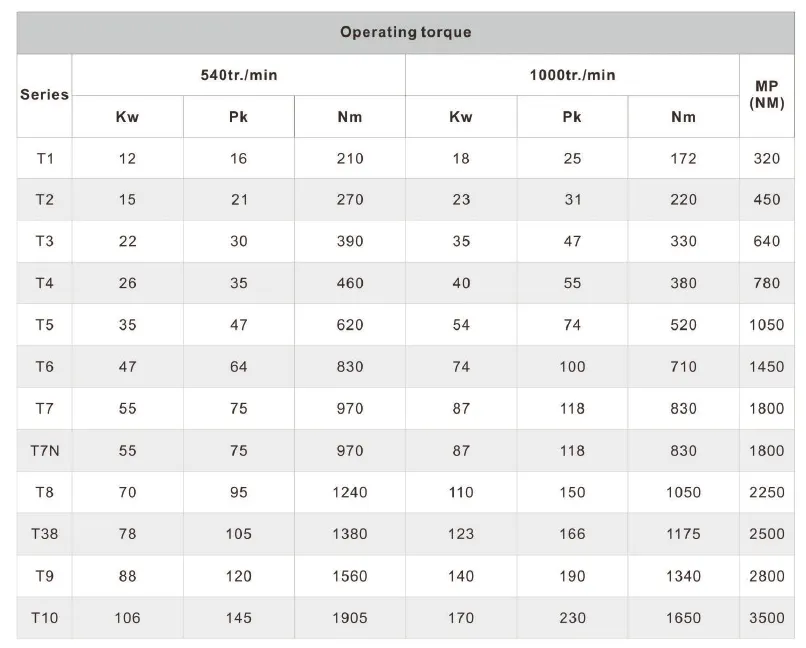
Note: the rated Nm at 1,000 rpm is always lower than at 540 rpm for the same series, because higher shaft speed increases dynamic loads on the cross-kit bearings.
Critical Difference: Torque Rating Changes with Speed
A common misconception is that a shaft rated at 590 Nm at 540 rpm can also deliver 590 Nm at 1,000 rpm. This is incorrect. The same shaft is rated at a lower Nm at 1,000 rpm because the cross-kit bearings experience higher dynamic loads at higher shaft speed. For T5, the ratings are 590 Nm at 540 rpm and 510 Nm at 1,000 rpm. Always use the Nm column matching your actual operating PTO speed when selecting a series.
How to Tell Which Standard Your Tractor Has
- 1
Count the splines on the tractor PTO stub with the tractor stationary and PTO disengaged.
- 2
Six splines: you have a 540 rpm Z6 stub. Twenty splines: you have a 1,000 rpm Z20 stub.
- 3
If in doubt, measure the major diameter of the stub splines: 34.9 mm = Z6; 44.5 mm = Z20.
- 4
Some tractors have dual-speed PTO — two stubs or a selector. Check the tractor operator manual.
- 5
Specify the confirmed speed when ordering from Drivlina med ständig kraft — both Z6 and Z20 yokes are available for all T, L, and S Series.
The 1,000E Economy Standard
The 1,000E variant delivers 1,000 rpm output at reduced engine speed — typically 1,400–1,700 rpm rather than the 2,000+ rpm of standard 1,000 rpm PTO. The spline interface is the same Z20 — the shaft specification is unchanged. The economy designation refers to the engine speed at which 1,000 rpm is achieved, not the shaft connection. A standard Z20 shaft works on both 1,000 and 1,000E tractors.
Order T Series with Z6 or Z20 Spline — Both In Stock
Standard Z6 and Z20 yoke profiles available for all T1–T10, L1–L32, and S6–S42 models. Specify PTO speed at order.
Tags
540 vs 1000 PTO shaft540 rpm PTO1000 rpm PTOZ6 vs Z20 splinePTO speed difference